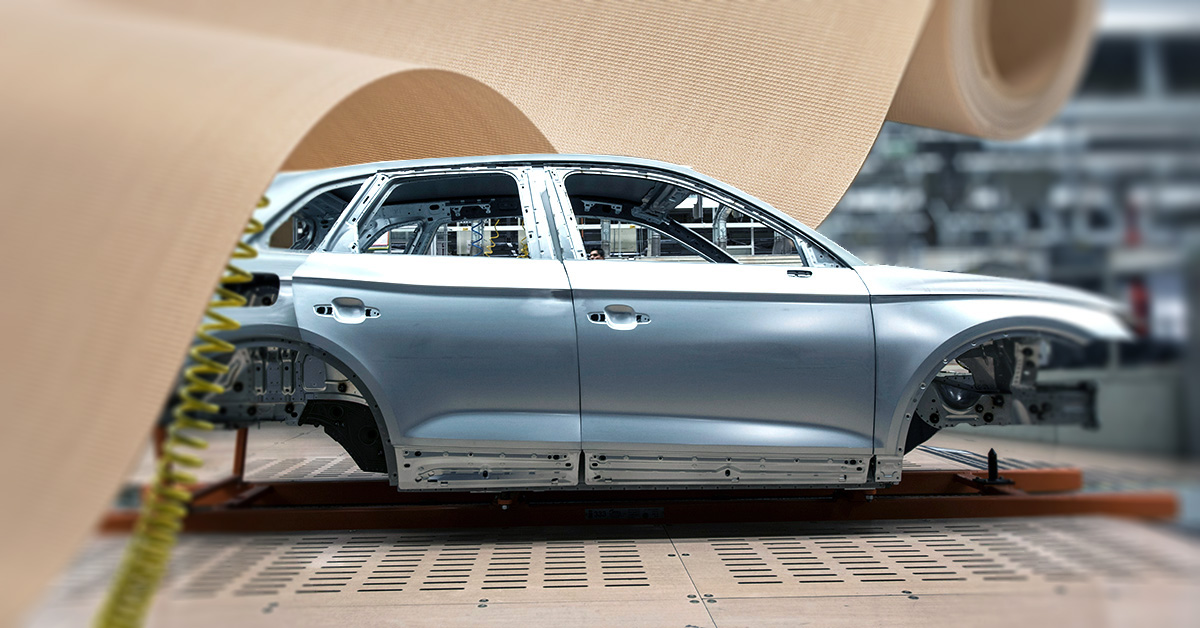
Today’s automotive sector puts a great deal of priority around the need to reduce waste in its processes. The industry continues to aim for more lightweight composites, and there is an essential need for mold release materials to play a key role in curbing the potential for by-products.
Mold release coated fabrics are materials treated with a non-stick substance like PTFE coating to prevent plastics, rubbers, or composites from sticking to molds, enabling easy and damage-free removal of finished parts during manufacturing.
Contact our team to find out more about Versiv mold release materials!
PTFE Coated Mold Release: Reduce Automotive Waste and Improve Parts Quality
Release material that minimises defects
Surface quality is essential in automotive composites. Any imperfection in the release material risks imprinting defects onto the finished part—visible blemishes that can render high-value components, like door panels, unusable. Technologies that minimise or eliminate such defects not only reduce scrap but also enhance the manufacturer’s reputation for quality.
The materials used must ensure smooth surfaces, less defects, and less scrap. If there is a defect in the mold cover, it will create an imprint or defect in the material that is compressed. The lesser defects the better for the manufacturer.
Enabling lightweighting and sustainability
Mold release strongly complements what manufacturers need to achieve in the development of automotive parts using composite materials. The materials facilitate the use of glass or natural fiber matrices—materials that offer superior stiffness at lower weights. This allows the number of plastics to be reduced, which serves to reduce the overall C02 footprint.
Without reliable mold release fabrics, these materials would be impractical to process, forcing manufacturers to revert to traditional, heavier plastics. That would only lead to the accumulation of higher emissions.
Key Considerations for Material Selection
Selecting the right mold release material is crucial. Cost effectiveness is the first consideration - then secondly supply chain availability. Third is lifetime and ease of use. By ease of use it is meant how convenient is what is supplied to the customer for their use – some customers require sheets, certain shapes, rolls, dedicated roll lengths – there needs to be that flexibility to make it convenient for the customer.
Release properties of PTFE
Polytetrafluoroethylene (PTFE) materials deliver a consistently smooth release, cycle after cycle.
- Extended durability: Advanced PTFE-coated tapes and fabrics can withstand thousands of molding cycles before having to be replaced.
- Reduced downtime: Fewer replacements have a knock-on effect in terms of reduced cleaning and lower associated costs.
The properties of these products all provide a consistently long lifetime and consequently reduce waste production. The capability to release easily means less chance of damage to automotive components.