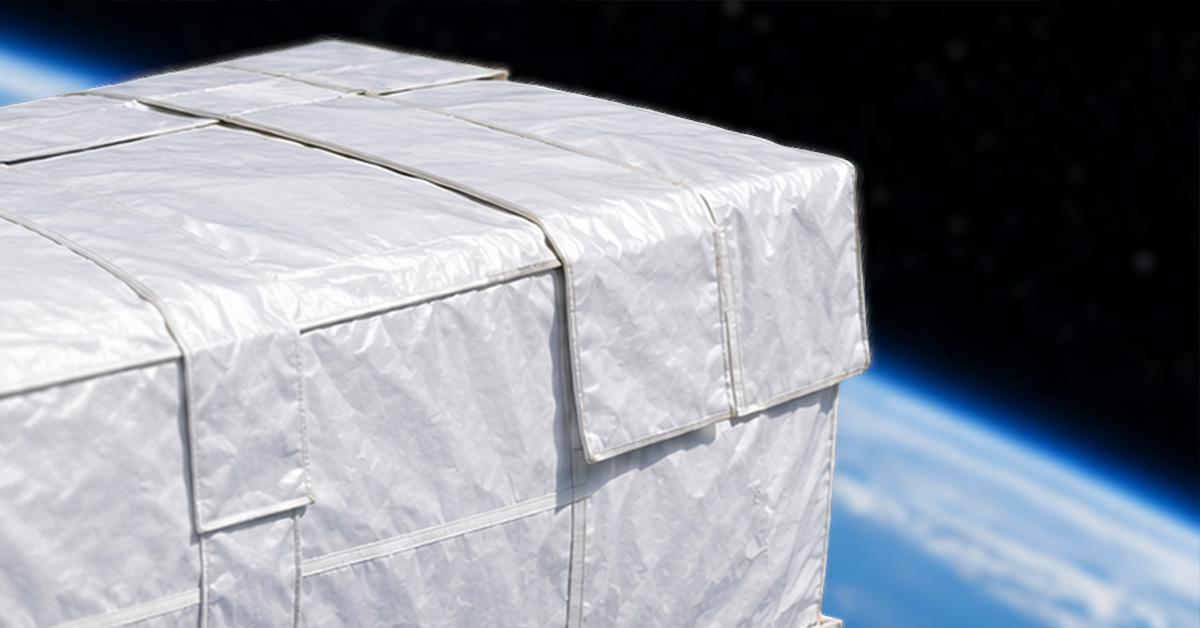
In the vacuum of space, heat cannot be managed in the same way it is on Earth. Multi-Layer Insulation (MLI) blankets are designed to help control temperature by slowing the transfer of thermal radiation between the spacecraft and its surrounding environment. Their performance comes from a layered construction, typically combining reflective films or foils with spacer materials and outer protective fabrics, creating a lightweight barrier that helps protect spacecraft hardware from extreme temperature changes.
The material architecture of a MLI is dictated by a varied number of factors, such as mission environment, spatial deployment and the vulnerability of the hardware it shields.
Below are a few key properties to consider:
Optical and Thermal Properties
Spacecraft Glint and Reflection Control
In space, shiny films or metallic surfaces can reflect sunlight into cameras, sensors, star trackers, optical payloads, or even toward astronauts. If glint is a concern, designers may choose a matte, diffuse, or specially treated outer surface instead of a highly reflective one.
Solar Absorptance for Thermal Control
Solar absorptance tells you how much incoming sunlight a surface absorbs. A high value means the material absorbs more solar energy and heats up more. A low value means it reflects more sunlight and stays cooler. For spacecraft thermal control, solar absorptance is one of the key properties used to predict surface temperature and energy balance.
Exterior and Interior Infrared Emittance Values
Infrared emittance tells you how effectively a surface radiates heat away as infrared energy. A high-emittance surface can reject heat efficiently. A low-emittance surface holds heat in better.
Exterior emittance matters for heat rejection to space; interior emittance matters for radiative heat exchange between the blanket, spacecraft structure, instruments, and internal surfaces.
Overall Effective Emittance
This is the thermal performance of the full material system, rather than of its external or internal layers.
In an MLI blanket, the effective emittance depends on layer count, spacers, compression, seams, stitching, perforations, venting, edge losses, and installation quality. Two materials with similar surface values can perform very differently once assembled into a blanket.
Electrical Properties
Electrostatic Discharge Prevention (ESD)
Spacecraft surfaces can build up electrical charge from plasma, solar radiation, or particle environments. If that charge suddenly discharges, it can damage electronics or disturb instruments. ESD-preventive materials are usually conductive or dissipative enough to let charge bleed away safely, often combined with proper grounding. NASA materials standards treat ESD, grounding, contamination, outgassing, and flammability as key spacecraft material-control concerns.
Atomic Oxygen Protection
Atomic oxygen is a major issue in low Earth orbit (LEO). It is highly reactive and can erode or degrade exposed polymers, films, coatings, and fabrics. If the spacecraft will operate in LEO, the exterior material may need atomic-oxygen-resistant coatings or inherently resistant outer layers.
Environmental Resistance
Contamination Control and Low-Outgassing Performance
In the space environment, materials can release trapped gases, residues, particles, or condensable vapours that may settle on nearby surfaces. This is especially critical around optics, sensors, cameras, radiators, solar arrays, and scientific instruments, where even small levels of contamination can affect performance.
For this reason, the industry-standard ASTM E595 test method is used to evaluate and qualify spacecraft materials for low-outgassing performance, helping to reduce contamination risks throughout launch, orbit, and long-term operation.
Solar and Cosmic Radiation Protection
Spacecraft are constantly exposed to a harsh spectrum of solar radiation, ranging from low-energy ultraviolet (UV) light to high-energy ionizing particles (like protons and cosmic rays). Combined, these radiation sources pose a dual threat: UV light degrades the exterior surface — cauzing polymers to crack, embrittle, and discolor — while high-energy particles penetrate deep into the spacecraft, damaging structural composites and disrupting internal electronics.
Material selection must address both threats simultaneously by utilizing UV-stable outer coatings (like fluoropolymers) coupled with high-density or hydrogen-rich shielding materials to absorb ionizing doses, ensuring the spacecraft's structural, thermal, and electronic integrity over its mission lifespan.
Mechanical Properties
Mechanical Load Performance Across Mission Conditions
This means checking how the material behaves under the physical loads it may experience across the mission. Examples include launch vibration, acoustic loading, handling, deployment movement, tension, folding, thermal cycling, and contact with hardware.
Minimal, optimal, and maximal scenarios usually mean: best-case, expected-case, and worst-case loading. The material must survive the worst case without tearing, shifting, shedding particles, blocking mechanisms, or losing thermal performance.
Venting and Pressure Equalisation Requirements
Venting means allowing trapped air or gases to escape. During launch and ascent, pressure drops quickly. If air is trapped inside a blanket, cavity, or between material layers, it can balloon, rupture, delaminate, or disturb deployment.
MLI Blankets have two faces: The side facing the spacecraft structure; and the side facing the external environment. Both may need controlled vent paths depending on how the blanket is attached and sealed.
Versiv Beta Cloth: The Outmost White Layer

Versiv Beta Cloth has a strong legacy of performance in the harsh space environment:
- Light, strong, and exceptionally tightly-woven: The Beta® fabric protects from atomic oxygen – especially when flying at low Earth orbit.
- Exceptional flex fatigue resistance compared to standard coated fabrics.
- Lightly coated to allow for low outgassing, making it ideal for space and aerospace missions.
- Highly resistant to the effects of thermocycling, solar and vacuum ultraviolet radiation.
- Ability to withstand harsh space conditions, serving as barrier and protection.
- Chemically inert: Resistant to corrosion and Atomic Oxygen effects
- Low electrical losses.
- ESD version available.
- Non-flammable and fire resistant.
- Non-silicone.
- ASTM E595 Compliant.
Want to learn more about Versiv Beta Cloth in MLI applications?
Contact us today!
Beta® is a registered trademark of Advanced Glassfiber Yarns LLC (AGY).