
Selecting the Materials for a Lunar Outpost
Moon habitation is moving closer to becoming a reality. With advances in robotics, researchers believe it may soon be possible to build permanent structures near the Moon’s South Pole - where sunlight is nearly continuous and the presence of water ice is a strong possibility.
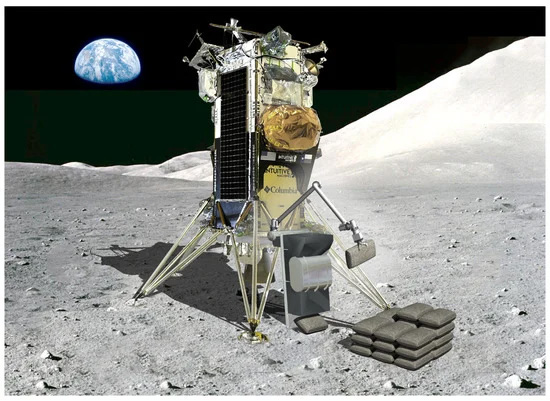
Future lunar settlement missions will need practical ways to build protective surface structures without launching large amounts of material from Earth. A proposed method is stacking containers filled with lunar soil, known as lunar regolith.
This construction concept is explored in details in the new article published by MDPI and co-authored by Steven Dubrule, Business Development Manager at Versiv Composites: "A Pathfinder Lunar Construction Mission Concept Using Regolith Filled Bags".
Read the full paper: A Pathfinder Lunar Construction Mission Concept Using Regolith Filled Bags by Dickinson, C.S.; Shi, F.N.; Vasudeva, K.; Mukherjee, R.M.; Blanchard, J.; Dubrule, S.; Empey, J.; Kugler, J.; Maghoul, P.; Ryan, A.J.; et al. Aerospace 2026, 13, 223.
The study presents a pathfinder mission concept focused on robotic excavation, bag filling and berm construction. The proposed mission would assess lunar regolith, use robotic systems to collect and bag it, and then verify the completed structure. The aim is to demonstrate a realistic early step toward building infrastructure from local materials. By using material already present on the Moon, missions may be able to reduce mass launched from Earth while improving surface resilience.
Versiv Beta Cloth for Lunar Regolith Containment
Any material intended for lunar regolith containment must handle sharp abrasive particles, extreme temperature swings, radiation exposure, sealing requirements, and the mechanical loads created by stacked filled units.
The design also requires a fabric that can retain fine regolith, be integrated into an automated bagging system, and remain suitable for robotic handling.
The researchers chose Versiv Beta Cloth due to its proven heritage and features:
- Light, strong, and exceptionally tightly-woven: with the fiber width measuring approximately 200 microns and the spacing between the weave at <5 μm
- Chemically inert: Resistant to corrosion and Atomic Oxygen effects
- Non-flammable and fire resistant.
- Highly resistant to the effects of thermocycling, solar and vacuum ultraviolet radiation.
The proposed Regolith Containment Units (RCUs) consist of sealable prefabricated rectangular bags sized at 0.4 m × 0.3 m × 0.2 m, with an estimated filled mass of about 30 kg. The design proposes PTFE impregnation on the internal side only, allowing for superior handling properties during filling, while the raw Beta Cloth on the exterior provides controlled friction between RCUs once stacked.
Interested in learning more about Versiv Beta Cloth?
Contact our specialists today.