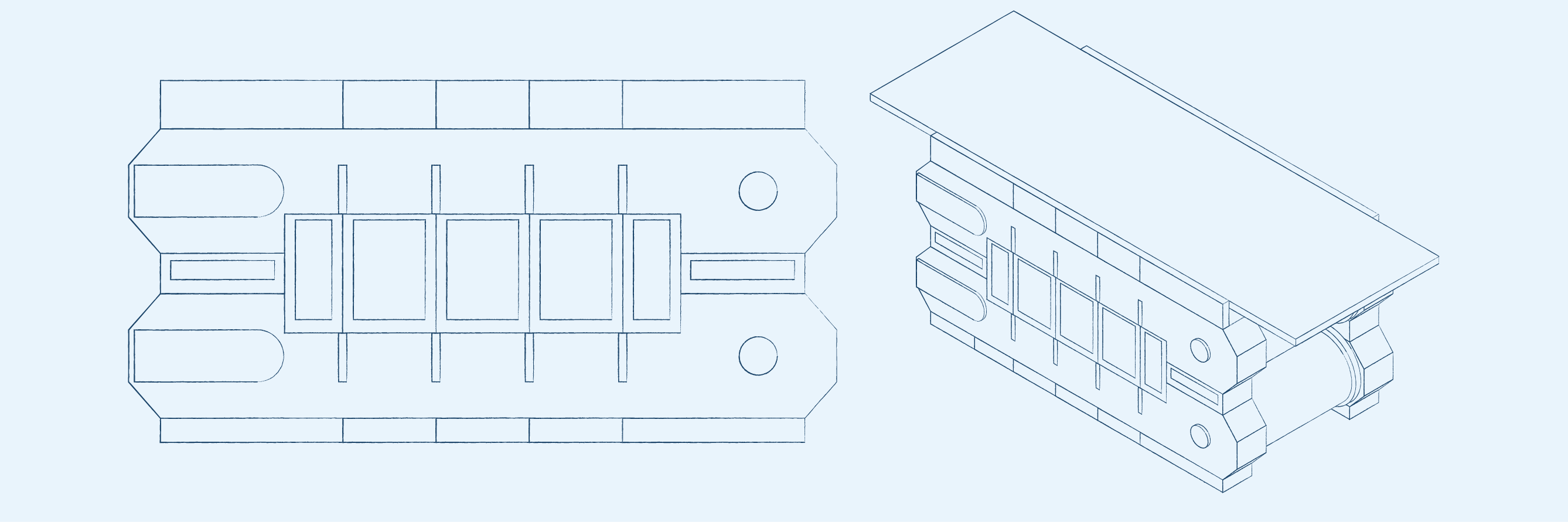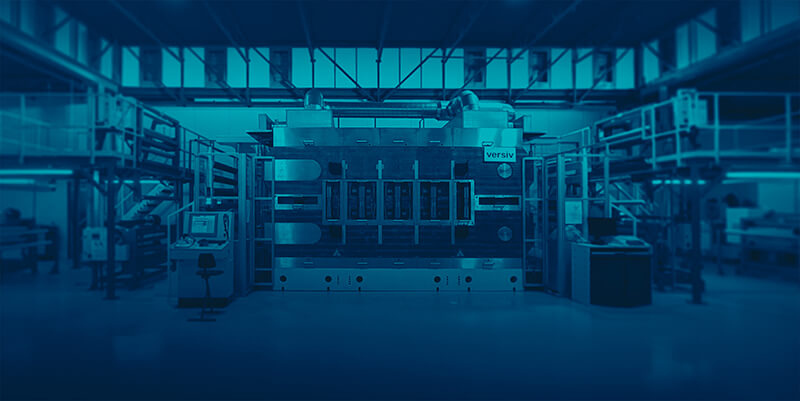
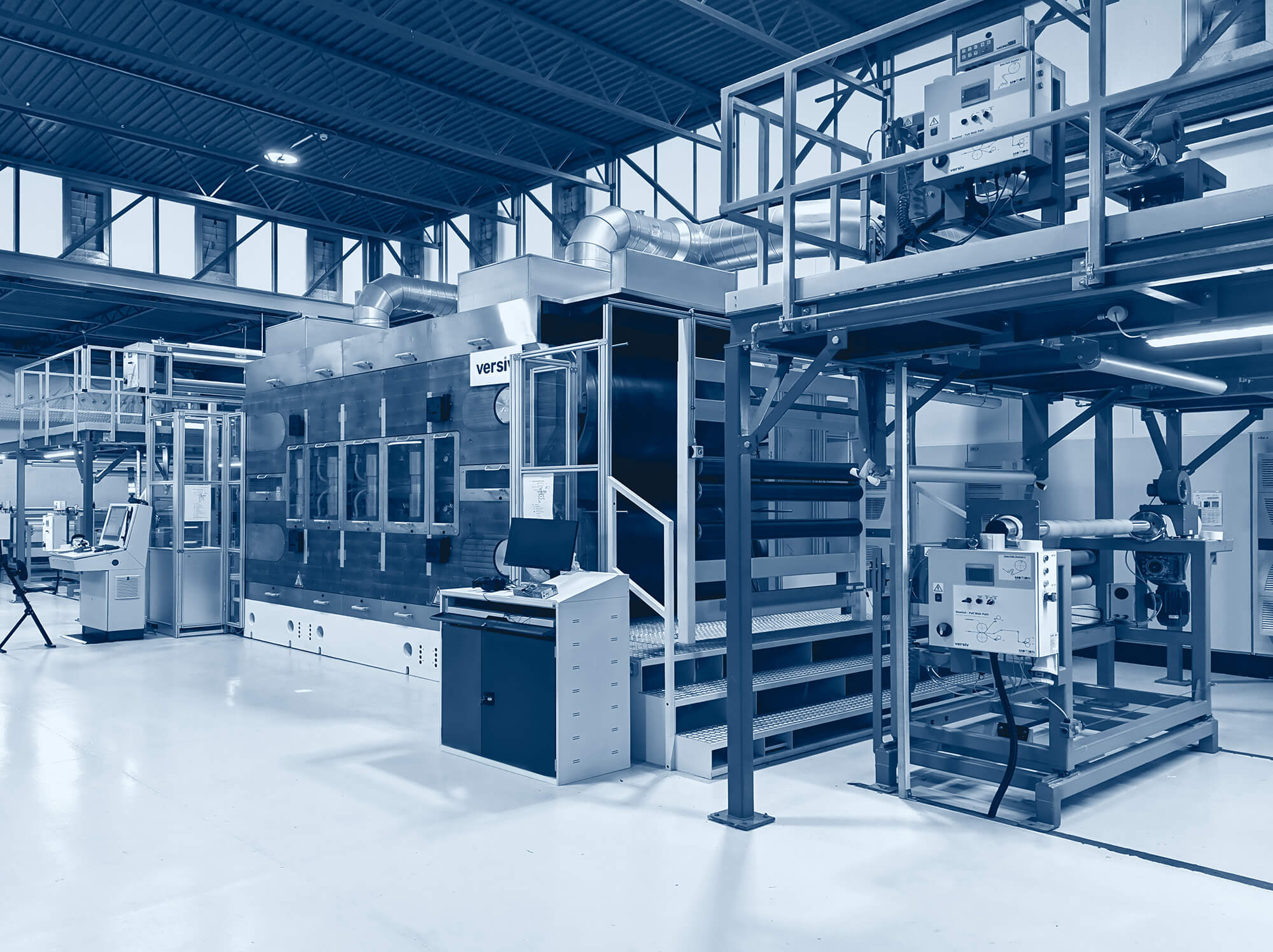
Our Versiv high temperature, high pressure double belt press provides a tightly controlled processing environment engineered to deliver repeatable, high-quality results across a wide range of composite materials.
max Width
1525mm
max isobaric pressure
80 bar
temperature range
80°C - 380°C
Speed
0.7 - 20m/min
processable layers
Up to 7 layers
Key Technical Features
Uniform isobaric pressure
Thermal control
Release options: Aluminium foil, copper foil or release spray
Custom texture options
High integrity laminates
Smooth surfaces
Continuous productivity
Reduced waste and costs
Uniform Lamination via Isobaric Pressure and Thermal Control
Our high temperature, high pressure double belt press system ensures that isobaric pressure is applied evenly across the full panel width and throughout the press length. Simultaneously, controlled thermal input supports uniform melting and curing behaviour, minimising thickness variation, surface defects, and the risk of incomplete cure.
This controlled environment creates predictable resin flow and effective air evacuation, while maintaining consistent fiber wet-out across laminates. By reducing internal stress gradients, our double belt press delivers consistent results with tight dimensional tolerances and reliable mechanical properties from run to run.
Contact us
Talk to our team of engineers to start working on your solution today!
Thank you! Your submission has been received!
Oops! Something went wrong while submitting the form.
*Mandatory Fields
Versiv Composites Limited is committed to protecting and respecting your privacy, and we will only use your personal information to administer your account and to provide the products and services you requested from us.
Your information is confidential and will not be shared with a 3rd party unless it is to assist the company in the operation of its business and the Site.
Double belt press lamination is a continuous roll-to-roll process that uses controlled heat, pressure, and dwell time to bond, consolidate, or process layered materials. It can be used for films, foils, fabrics, adhesives, thermoplastics, and multi-material composite constructions.
How is double belt press processing different from hot calendering?
Hot calendering uses heated rolls and typically has a shorter dwell time. A double belt press provides continuous uniform pressure over a longer heated zone, which can offer better consolidation, more controlled resin flow, and improved consistency for certain laminates.
What materials can be processed?
A range of materials can be processed, including films,foils, fabrics, reinforcement layers, adhesives, thermoplastics, and othercomposite constructions. Suitability depends on the material combination,processing temperature, pressure requirements, and final product goals.
What are the benefits of using a double belt press?
A double belt press provides continuous processing with controlled heat, pressure, dwell time, and cooling. This helps support consistent consolidation, controlled thickness, smooth surface finish, effective air evacuation, and repeatable laminate quality. Depending on the lamination temperature and process requirements, cooling can be integrated at the end of the press or managed through a dedicated cooling zone.
How can double belt press tolling support product development and production?
Double belt press tolling allows customers to access our continuous lamination capabilities without investing in their own equipment. We process customer-supplied materials using our double belt press, supporting product development, trials, scale-up, and ongoing production. Where required, trials can be carried out with customer supervision or participation, allowing process conditions and laminate outcomes to be reviewed directly during development.
Is double belt press tolling suitable for trials and development work?
Yes. Tolling is ideal for early-stage trials, materialvalidation, process optimisation, and scale-up before committing to largerproduction volumes.
Can it be used for full production?
Yes. Once the process and material construction are validated, double belt press tolling can support repeat production with consistent processing conditions.
Do you provide process recommendations?
Yes. Our team can review the material construction and intended application to help identify suitable starting conditions for trials.
Can customers supply their own materials?
Yes. Customers can supply their own films, fabrics, foils, adhesives, or other materials for toll processing, subject to technical review.
How do I know if my material is suitable?
The best approach is to share the material construction, processing requirements, and target performance. From there, the team can assess whether double belt press tolling is a good fit.
What information is needed before starting a trial?
Typical starting points include material types, layer structure, target thickness, required width, temperature limits, pressure requirements, desired surface finish, and final application. Where applicable, customers should also provide relevant technical data sheets and safety data sheets to support process review and material handling requirements.
Can different surface finishes be achieved?
Yes. Depending on the material construction and release surface used, differentsurface finishes and textures may be possible.
What applications can double belt press tolling support?
It can support applications across composites, industrial laminates, technical textiles, insulation materials, protective layers, release surfaces, and multi-material composite constructions and many more.
Can laminated materials be slit or spooled after processing?
Yes. Additional converting steps such as slitting, spooling, rewinding, and roll preparation can be considered depending on the material construction, finished width, roll length, and handling requirements.