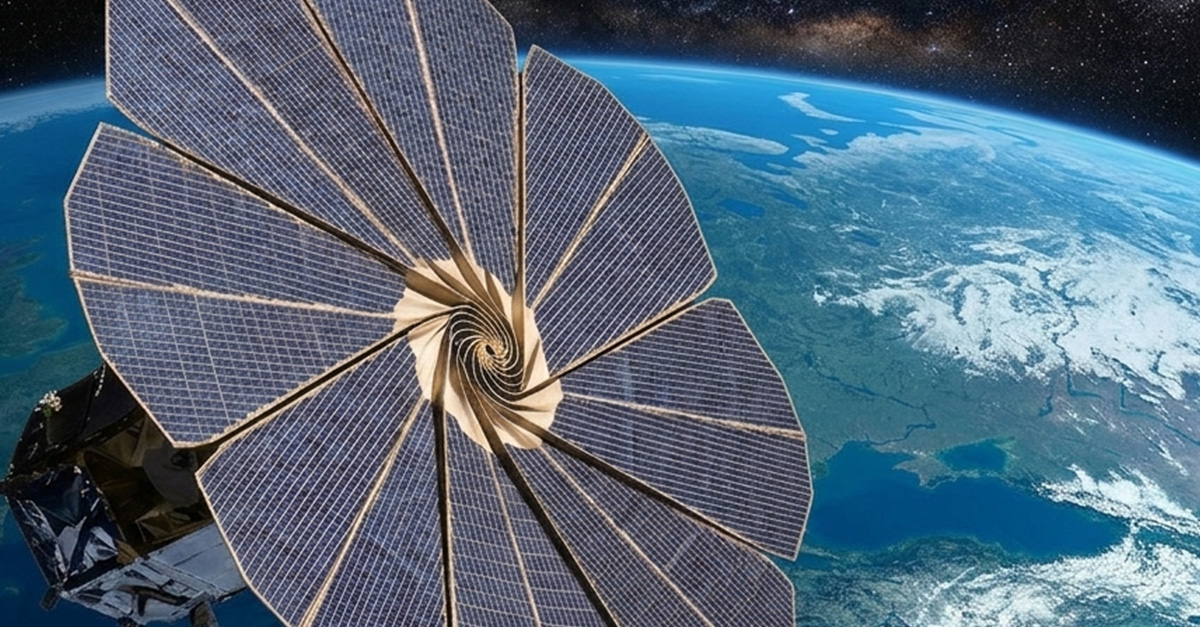
Conceptual rendering of a deployable space structure.
The economics of space exploration come down to a challenging reality: rocket fairings are limited in size, while the structures needed in orbit can be enormous.
To capture solar energy, transmit data or harness solar radiation for propulsion, spacecraft often require surface areas that simply cannot be launched in their final, rigid form.
The solution lies in space deployables — structures designed to launch in a compact configuration and unfold, unfurl or expand once in orbit. While mechanical booms, hinges and deployment motors often receive the most attention, the success of these origami-like systems also depends on a critical material property: drapability.
This article explores what drapability means in space applications, why it is essential to modern deployable structures and how it is helping shape the future of off-Earth engineering.
Did you know we supply specialised materials for space deployables?
Our Versiv SPX3 is a specialised fabric that possesses excellent flexibility and crease characteristics — powered by the inherent properties of PTFE, and highly customisable.
Contact us today to learn more!
What is Drapability in Space Deployables?
In terrestrial textiles, "drape" refers to how afabric hangs or conforms to a shape under its own weight. In aerospace engineering, drapability is the ability of a membrane, composite mesh, or thin-film fabric to fold tightly, conform to complex stowed geometries, and deploy repeatedly without permanent wrinkling, creasing, or structural failure.
Because space structures operate in microgravity, they don't have to support their own weight, allowing engineers to replace heavy, rigid panels with ultra-thin, flexible membranes. However, these materials must survive being packed under high pressure for months and then subjected to the violent vibrations of a rocket launch. If a material lacks sufficient drapability, the stresses of folding will cause micro-fractures, delamination, or permanent creases— leading to a jammed deployment or a compromised mission.
Why Drapability is Crucial for Mission Success
Deployable space structures rely on drapability to solve three critical engineering bottlenecks:
- Launch Volume Efficiency: A highly drapable material can be tightly folded using intricate origami-inspired tessellations (like the Miura-ori fold). This allows structures larger than a tennis court to be packed into a payload fairing no bigger than a compact car.
- Predictable Kinematics When a structure unfurls in space, it must do so smoothly. Materials with poor drapability suffer from hysteresis— a resistance to returning to their original shape — which can cause unpredictable snags or "blossoming" (where a rolled structure unspools unevenly).
- Tensioning and Surface Accuracy: Once fully deployed, structures like antennas and solar sails must be stretched taut over a lightweight rigid frame. The material must drape perfectly over this skeleton to maintain a highly accurate, pre-loaded shape without sagging.
The Engineering Challenges of the Space Environment
Achieving perfect drapability on Earth is difficult; achieving it in space is a monumental challenge. Materials engineers mustaccount for extreme environmental factors:
- Thermal Extremes: In orbit, a membrane might swing from -150°C in Earth's shadow to +150°C in direct sunlight. Many polymers that are highly drapable at room temperature become dangerously brittle and prone to shattering at cryogenic temperatures.
- Atomic Oxygen and Radiation: Materials in Low Earth Orbit (LEO) are bombarded by highly reactive atomic oxygen and ultraviolet radiation, which degrades polymers over time, altering their flexibility and drape characteristics.
- Creep and Relaxation: If a membrane is folded and packed tightly for years before launch (a common scenario for deep-space missions), the material may "creep," taking on a permanent set that prevents it from tensioning correctly upon deployment.
PTFE Properties address these challenges
Polytetrafluoroethylene (PTFE) is a high-performance fluoropolymer valued for its non-stick behaviour, low coefficient of friction, thermal stability and chemical inertness.
When incorporated into composite films or reinforced fabrics, PTFE can help deployable space structures withstand demanding environmental conditions. Its low moisture absorption and resistance to ultraviolet exposure support stable surface and mechanical performance across changing orbital environments. PTFE’s exceptionally low surface energy also helps reduce friction and adhesion between folded layers, supporting smoother deployment and lowering the risk of ultra-thin membranes sticking together after prolonged storage. Combined with lightweight reinforcement materials, it can provide a flexible protective barrier without significantly increasing the mass or stowed volume of the structure.
Did you know we supply specialised PTFE materials for space deployables?
Contact us today to learn more!
The Future of Space Deployables
The future of space deployables is moving toward smart materials. Advanced computational modeling is allowing researchers to design entirely new geometric folding patterns, pushing the limits of how tightly a membrane can be packed without compromising its structural integrity.
As we look towards ambitious goals like orbital solar power stations and crewed missions to Mars, our success will not just depend on the size of our rockets, but on our ability to fold, drape, and deploy the infrastructure of the future.