
Back arrow
Renewable Energy Icon
Lösungen für
Renewable Energy
VORGESTELLT

PTFE-Formtrennfolien für die Herstellung von Windflügeln

PTFE-beschichtete Versiv-Gewebe sorgen für ein einfaches Entfernen von geformten Windturbinen, ohne dass Harze übertragen werden.
Kontaktiere uns
Keine Artikel gefunden.
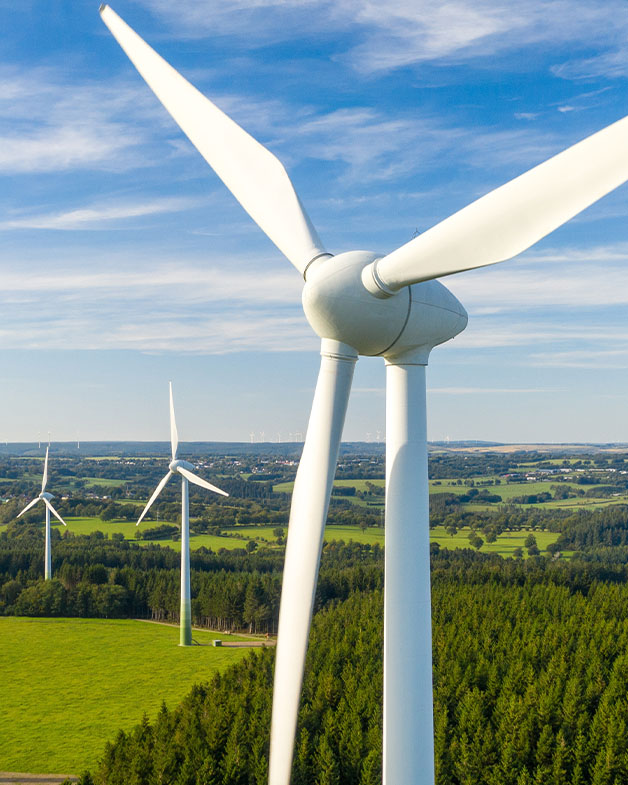
Bild eines Windflügels vor blauem Himmel und grünen Feldern.

Versiv-Produkte der Wahl für die Herstellung von Windkraftanlagen

Product
Description
Laminated products with superior release and extended durability. Silicone pressure adhesive added to one side.

Features

  • Flexibel und schweißbar
  • Hervorragende antihaftbeschichtete PTFE-Oberfläche
  • Mechanisch stabil unter Druck
  • Thermisch stabil bis 500°F/260°C
  • Beständig gegen geschmolzene Thermoplaste
  • Exzellente Wärmeübertragung
  • Konsistenter mechanischer Verschleiß
  • Macht den Einsatz von Trennmitteln oder Silikonsprays überflüssig
  • Führbare Kanten
  • Benefits

  • Fehlerfreies Produkt
  • Weniger Materialverschwendung
  • Verbesserte Kosteneffektivität
  • Höhere Oberflächenqualität
  • Minimierung des Risikos ungeplanter Wartungsarbeiten
  • Konsistente Produktionsprozesse
  • Verbesserte Produktivität
  • Keine Kreuzkontamination
  • Versiv materials support growth in the hydrogen energy market in two ways:
    • As components: stacking materials inside fuel cells and electrolysers.
    • As processing aids for catalyst coating and lamination of Catalyst Coated Membranes (CCMs), present inside Membrane Electrode Assemblies (MEA).

    Main Benefits of Versiv Materials for Hydrogen Fuel Cells and Electrolysers:

    High chemical resistance:

    Versiv PTFE films and coated fabrics are highly resistant to chemicals – such as strong acids and bases – making them ideal for use in the harsh chemical environment of hydrogen fuel cells and electrolysers.

    Excellent electrical insulation:

    Versiv PTFE films are excellent electrical insulators. These fluoropolymer-based materials serve as separators between cell layers, preventing electrical contact between the anode and cathode.

    High-temperature resistance:

    Versiv PTFE films and coated fabrics have excellent high-temperature resistance. They can withstand temperatures up to 260°C (500°F) without degradation, ensuring long-term performance and reliability.

    Low permeability to gases:

    Versiv films have extremely low permeability to gases, including hydrogen, which is the key component in fuel cells and electrolysers. This property ensures that hydrogen gas is contained within the cell and does not leak out.

    Stacking Materials inside Fuel Cells and Electrolysers

    Versiv composites are used as frames and gaskets within the fuel cell system. They provide modularity to the system, protecting the protect graphite Bi-polar plates and ensuring the energy efficiency of the fuel stacks.

    Problems solved:

    • Early leakage
    • Inhomogeneous pressure distribution

    Applications:

    • Membrane Electrode Assemblies (MEA) Systems:
      • Proton-Exchange Membrane (PEM) electrolysers & fuel cell systems
      • Alkaline electrolysers & fuel cell systems
    • Phosphoric Acid Fuel Cells (PAFC)

    Versiv Products of Choice for Fuel Cells and Electrolysers

    Virgin PTFE Cast Film: For thinner gauges, uniform, pinhole and crack-free, isotropic product with low permeability for frame and sub-gaskets.
    Modified PTFE Film
    High dielectric break down strength, weldable and low permeability for frame gaskets.
    Please contact us to further discuss your requirements.
    Polyimide-based composite coated with fluoropolymer.
    Smooth surface and good friction properties for sub-gaskets.
    Please contact us to further discuss your requirements.

    Features

    • Low thickness tolerance
    • Excellent non-stick surface
    • Excellent dielectric properties
    • Superior chemical resistance
    • Excellent smooth surface
    • Low shrinkage/hysteresis
    • Excellent heat transfer
    • High temperature resistance up to 260°C / 500°F

    Benefits

    • Durable sealing properties
    • Low permeability
    • Providing multiple gasketing functions
    • Low risk of failure due to chemical inertness
    • Usable in harsh environments
    • Reliable mechanical protection
    • Bondability to the PEM
    • Tight seal under pressure holding the PEM in place

    Decal substrates for fuel cell Catalyst Layer production

    Versiv materials work as a very precise, smooth and thickness-controlled decal substrate in the production of catalytic layers via decal transfer method. In a second step this substrate becomes a release liner with excellent release properties ensuring that the substrate can be removed without damaging the very costly catalytic layer.

    Problems solved:

    • Thermal hysteresis
    • Non-perfect wetting
    • Non-perfect transfer

    Applications:

    • Processing aids for catalyst coating and lamination of Membrane Electrode Assemblies (MEA)

    Versiv Products of Choice for Catalyst Layer Production

    Smooth surface and durable release for decal substrates.
    Smooth, uniform surface with superior release properties for decal substrates.
    Surface allowing wettability and release in combination to strong material properties; low thermal hysteresis.
    Please contact us to further discuss your requirements.
    Surface allowing wettability and release in combination to exceptional smooth surface and reduced thermal hysteresis.

    Features

    • Low thickness tolerance
    • Excellent non-stick surface
    • Excellent dielectric properties
    • Superior chemical resistance
    • Excellent smooth surface
    • Low shrinkage/hysteresis
    • Excellent heat transfer
    • High temperature resistance up to 260°C / 500°F

    Benefits

    • Improved productivity due to higher process speed
    • Optimal release, allowing both wettability and release
    • Low risk of creasing
    • Less downtime
    • Consistent production processes
    • Low risk of failure due to chemical inertness
    • Increased cell efficiency by thinner catalyst layers

    PTFE-Freigabe für die Oberflächenqualität bei der Herstellung von Windenergieflügeln

    Der Herstellungsprozess unter Verwendung von Versiv-Komponenten beinhaltet die Integration von PTFE-beschichteten Stoffen und Bändern, um effektive Trennfolien herzustellen. Diese Materialien sind so konzipiert, dass sie den Strapazen der Produktion standhalten und gleichzeitig eine hervorragende Leistung bei der Verhinderung von Verklebungen bieten und eine hochwertige Oberflächenbeschaffenheit gewährleisten.
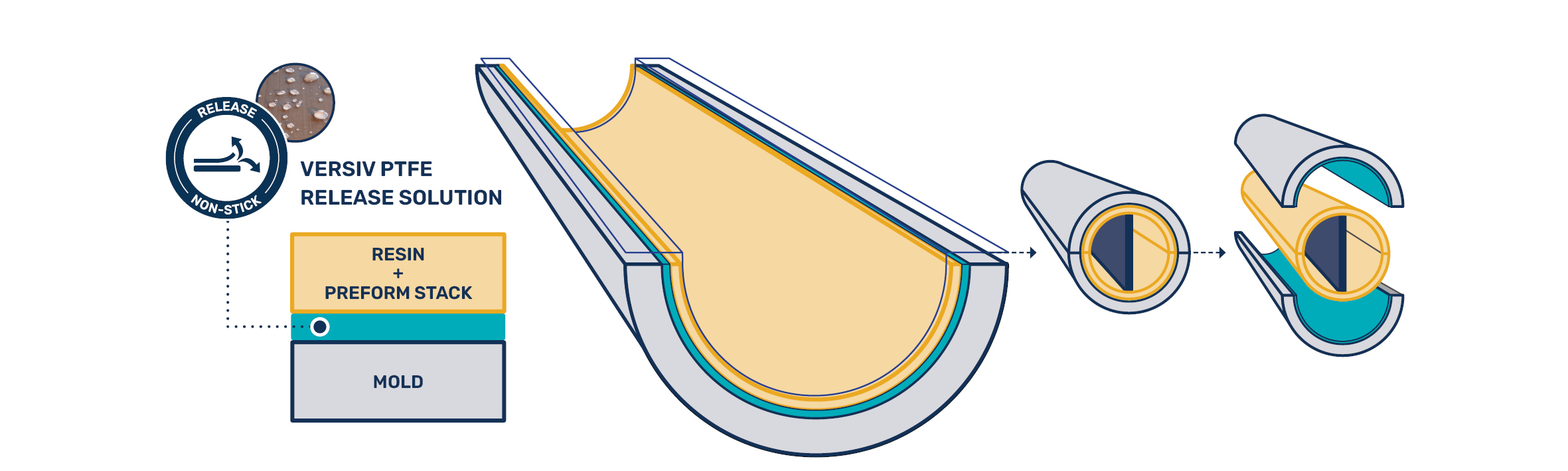
    Versive Materialien bedecken die Form.

    Die enormen Kräfte und Temperaturen bei der Herstellung von Verbundwerkstoffen stellen eine hohe Belastung für Formen, Teile und Materialien dar. Versiv CLPSA 4 ist ein laminiertes PTFE-beschichtetes Gewebe, das so konzipiert ist, dass es dieser herausfordernden Umgebung standhält.

    Versiv CLPSA 4 S ist ein wiederverwendbarer und langlebiger Ersatz für schmutzige Wachse und Sprays. Es ermöglicht fehlerfreie Produkte mit qualitativ hochwertigeren Oberflächen, wodurch die Notwendigkeit einer weiteren Verarbeitung reduziert wird.

    Die auf einer Seite angebrachte Silikon-Druckklebeschicht sorgt dafür, dass sie an ihrem Platz bleibt und gleichzeitig die Form und das Werkzeug schützt und deren Lebensdauer verlängert.
    What can be made with
    Versiv PTFE Release Solutions?

    No items found.
    Driving Decarbonisation:  Unveiling the Role of PEMFC, AFC, PEMEL, and AEL Technologies in Advancing Fuel Cells and Electrolysers
    Versiv White Paper

    Driving Decarbonisation: Unveiling the role of PEMFC, AFC, PEMEL and AEL technologies in Advancing Fuel Cells and Electrolysers

    Transform your approach to hydrogen electrolysis.
    Subscribe and get your free copy of our industry-leading white paper today and propel your clean energy initiatives forward.

    Versiv Composites Limited is committed to protecting and respecting your privacy, and we’ll only use your personal information to administer your account and to provide the products and services you requested from us. Your information is confidential and will not be shared with a 3rd party unless it is to assist the company in the operation of its business and the Site.
    For more information, please read our Terms of UsePrivacy Policy

    Frequent Asked Questions

    How do Versiv materials contribute to improved fuel cell efficiency?
    caret down
    What are the key considerations when selecting materials for PEMFC gaskets and sub-gaskets?
    caret down
    How do sealing solutions contribute to the overall efficiency and lifespan of PEMFC stacks?
    caret down
    What role do Versiv materials play in fuel cell catalyst layer production?
    caret down
    What are the key features of Versiv products for catalyst layer production?
    caret down

    Key Takeaways

    Hydrogen electrolysis and fuel cells are increasing sources of sustainable clean energy and will form the foundation of a new era of energy usage. The environmental benefits of hydrogen — its abundance, superior energy efficiency, and cleanness — make it a strong candidate for becoming our main source of energy over the coming decades, as the world grapples with climate chang eand clean energy target achievement.
    • Hydrogen fuel cells provides a clean and efficient way to store and transport energy for use in homes, businesses, and vehicles.
    • Electrolysis is currently the leading process for hydrogen production, as it can result in zero greenhouse gas emissions, depending on the source of electricity used.
    Two men and a woman with PPE discuss a document in factory floor
    Strenge Teststandards
    Versiv entwickelt maßgeschneiderte Anwendungstests, die auf den einzelnen Produktverwendungen unserer Partner basieren, um die bestmögliche Lösung zu finden. Einige Tests, die im Lieferumfang enthalten sind, aber nicht auf Umwelt-, Haltbarkeits- und Zuverlässigkeitstests beschränkt sind, geben Ihnen die Gewissheit, dass die Produkte in den rauesten Umgebungen funktionieren. Unsere Tests beginnen während des gemeinsamen Entwicklungsprozesses, um relevante Tests zu entwickeln und Daten zu sammeln, die es uns ermöglichen, schnell marktreife Lösungen zu entwickeln.
    Some of our tests:
    • FTMS 191A-5041

    • FTMS 191A-5030

    • FTMS 191A-5102

    • FTMS 191A-5136

    • ASTM D149-81

    Wie können wir helfen?
    Sprechen Sie mit unserem Ingenieurteam, um noch heute mit der Arbeit an Ihrer Lösung zu beginnen!
    Kontaktiere uns