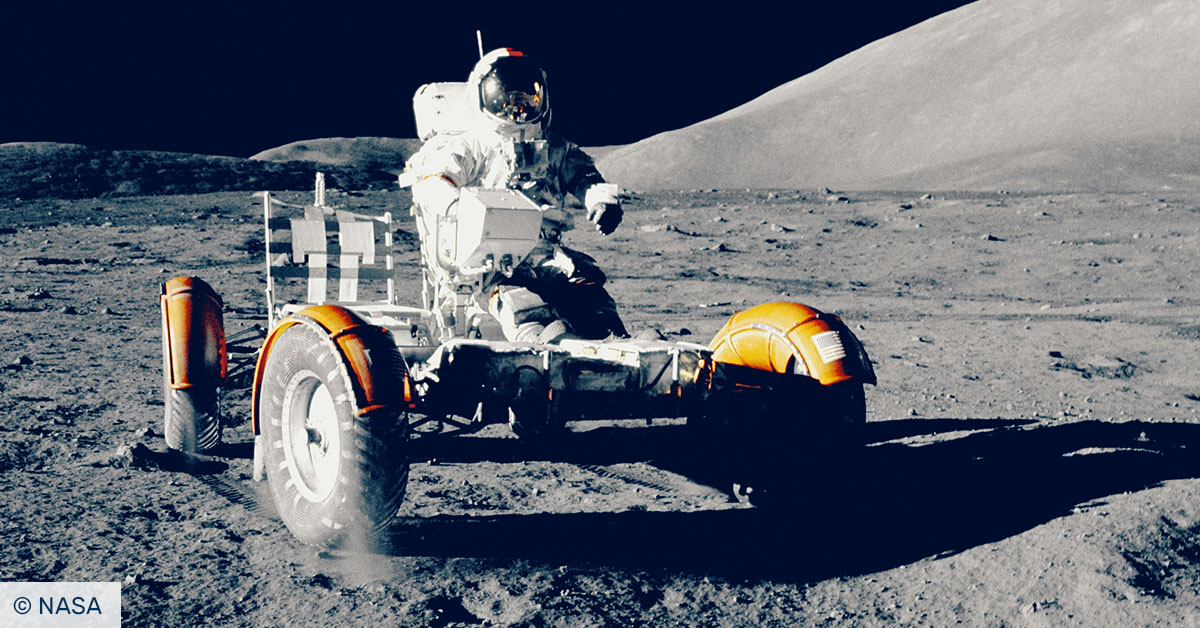
Apollo 17 astronaut Gene Cernan in 1972. Image from Nasa.
Managing fine and stubborn lunar regolith
Created by billions of years of meteorite impacts pulverising rock - moon dust, or lunar regolith, is composed of tiny, sharp, and clingy particles. Historically, moon dust caused serious complications to the Apollo missions: it wore down suits, jammed seals and joints, reduced radiator performance, and even irritated astronauts’ eyes and lungs after it got inside the cabin.
Because lunar regolith causes major issues, developing mitigation technologies such as electron-beam (e-beam) cleaning is mission-critical.
What is electron beam cleaning?
Electron beam is a specialised, non-contact, technology that uses a focused beam of electrons to charge the dust particles, so that electrostatic forces overcome the sticking forces that hold dust in place.
A new study in Acta Astronautica explores a promising approach: cleaning spacesuit fabric with a low-energy electron beam works even better under sunlight-like vacuum ultraviolet (VUV) illumination, the type of ultraviolet light that reaches the Moon’s surface because there is no atmosphere to filter it.
Versiv has provided the researchers with samples of Versiv Beta Cloth - our space especialised PTFE-coated fiberglass fabric, present as the outer layer in the multilayer insulation blankets (MLIs) that protect space equipment and suits.
Read the full paper: Electron-beam lunar dust mitigation under solar-like vacuum ultraviolet illumination by Josef L. Richmond, Joshua R. Machacek, Christine Charles, Roderick W. Boswell
Adding solar-like vacuum ultraviolet illumination to the testing environment
Many lab tests neglect the vacuum ultraviolet (VUV) part of sunlight, despite it being the main driver for photoelectric charging - that is, for surfaces and dust to build up electric charge on the Moon’s dayside. The study from Richmond, Machaecek, Charles and Boswell shows that this solar-like VUV can supercharge the cleaning effect, lowering power needs and speeding up dust removal.
These samples were contaminated with a lunar regolith simulant. The researches then tried to remove the dust in a vacuum chamber using:
- a thermionic electron beam (≤120 eV, low-energy electrons), and
- VUV light designed to mimic the Sun’s spectrum in the 115–160 nm range, including the strong Lyman-α line at 121.6 nm.
They compared three lighting environments:
- No VUV (“dark”)
- Lunar-equivalent VUV (0.3 mW/cm²)
- Elevated VUV (5 mW/cm², an intentionally strong case)
The team measured two practical outcomes:
- How much electron-beam “push” is needed to start dust moving (the mobilisation threshold)
- How quickly and how thoroughly the dust is removed (dust removal efficiency over time)
Interested in testing with Versiv Beta Cloth?
Contact our specialists today.