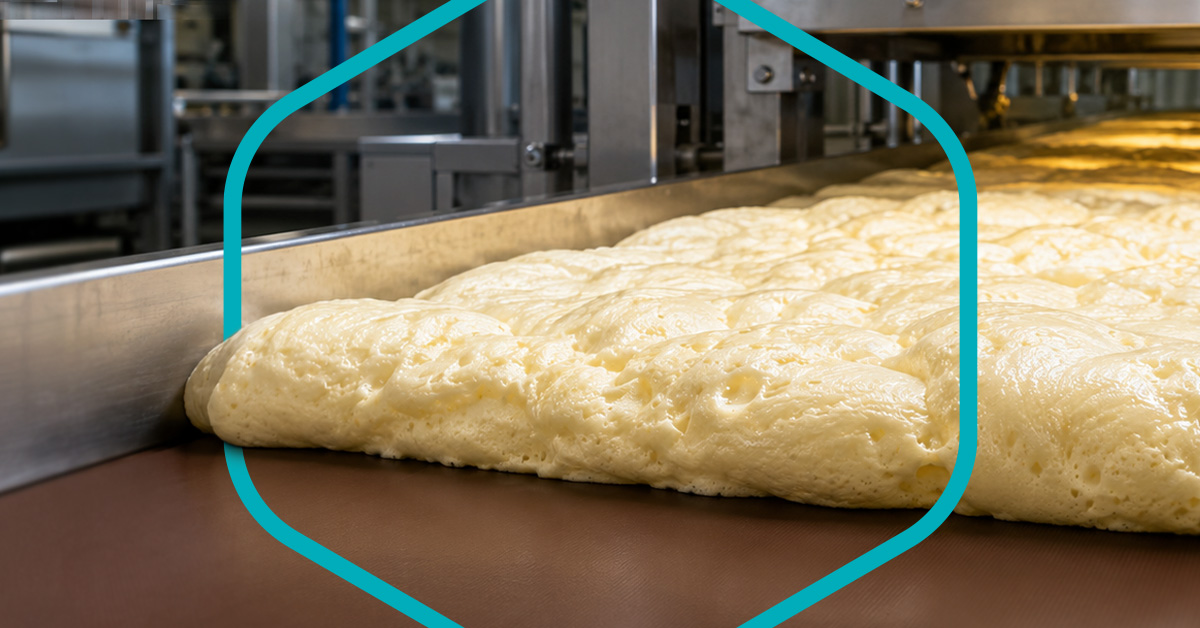
Uncured foam is intensely sticky, delicate, and constantly reacting.
Standard plastic or steel conveyors fail in this environment — ruining the delicate, tacky foam while suffering rapid degradation themselves. PTFE belts solve this by directly targeting every physical and chemical vulnerability of the early curing stage.
Key Advantages of PTFE Belts in Foam Processing
Versiv PTFE materials act as a release surface for all the processing stages of polymeric materials into foam products.
Read more!
1. Ultra-Low Surface Energy (Anti-Adhesion)
Unreacted monomers and polymers are usually relatively polar and form strong physical bonds with almost anything they touch. PTFE has one of the lowest coefficients of friction and lowest surface energies of any solid material.
The sticky, expanding chemical foam mix cannot form "adhesive" bonds with the PTFE surface. As the foam expands and cures into a block or sheet, it releases cleanly from the belt at the end of the line without tearing its delicate outer skin or leaving residue.
2. High Thermal Resistance for Exothermic Curing
Foam expansion is a physical and exothermic chemical reaction. Curing ovens and natural reaction heat can drive internal foam temperatures above 150°C to 200°C (300°F – 400°F).
Standard conveyor belts (like PVC or steel mesh) melt, degrade, or warp under sustained high temperatures. PTFE-coated fiberglass belts easily withstand continuous operating temperatures up to 260°C (500°F) without losing structural integrity or non-stick performance.
3. Extreme Chemical Inertness
The chemical precursors for foam — such as polyurethane isocyanates, polyols, catalysts, blowing agents, and flame retardants — are chemically aggressive and highly corrosive to standard plastics.
The carbon-fluorine bonds in PTFE make it chemically inert. It will not degrade, swell, or react when exposed to aggressive foam formulations, ensuring the belt lasts for many production cycles.
4. Dimensional Stability & Smooth Topography
During the gel phase, any unevenness or defect on the conveyor surface translates directly into permanent defects on the foam's surface surface and provide an anchor point for the curing polymer.
Versiv PTFE coated fabrics combine advanced fluoropolymer technology with ultra-durable fiberglass reinforcement. This dimensional stability prevents belt distortion under thermal and mechanical stress, maintaining a precise, flat surface that supports uniform foam expansion and optimizes overall cell density.
Want to learn more about our materials?
Contact us today!