What Is PTFE?
PTFE stands for polytetrafluoroethylene, a high-performance fluoropolymer made from tetrafluoroethylene. It is a highly valuable component to advanced materials because it combines excellent chemical resistance, low surface adhesion, broad temperature capability and strong electrical insulation.
The chemical structure behind PTFE properties
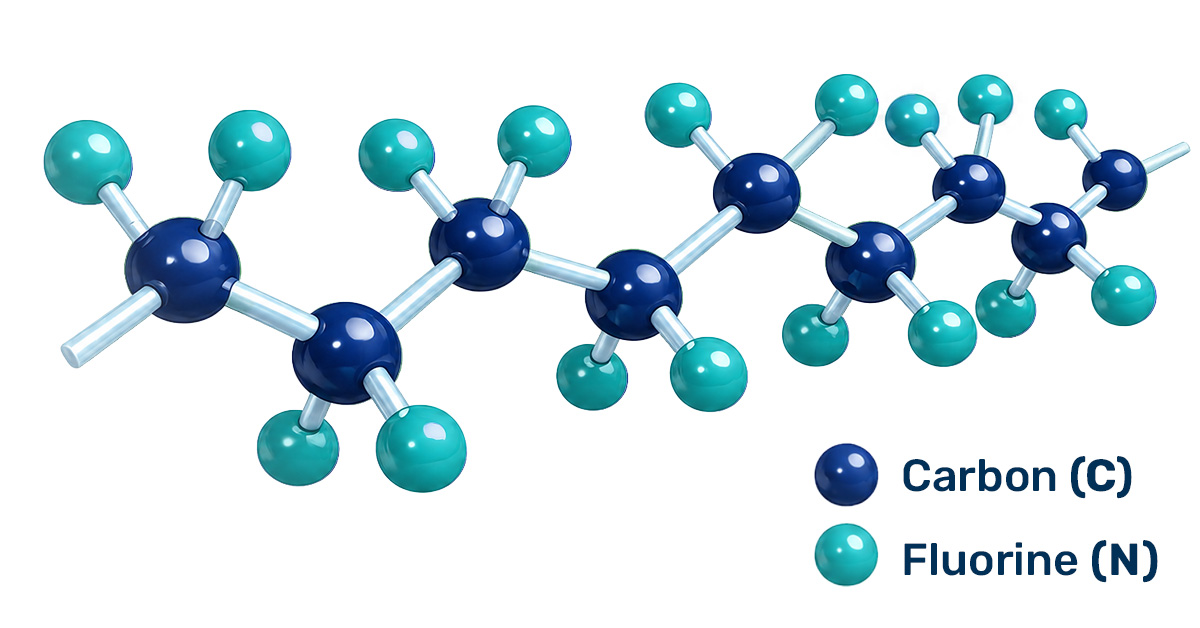
PTFE owes its exceptional resistance to heat, chemicals, and environmental degradation to its unique molecular architecture.
- The Carbon Backbone: The core of the polymer is a strong chain of carbon-carbon bonds.
- The Fluorine Shield: Surrounding this backbone is a dense, helical sheath of fluorine atoms. Because fluorine atoms repel one another, they force the chain into a tight twist.
- Steric Protection: This helical twist packs the fluorine atoms so closely together that they create a seamless, protective barrier.
Because the carbon-fluorine bond is one of the strongest in chemistry, and the dense fluorine packing physically blocks outside molecules from reaching the carbon core, PTFE is virtually impossible for chemicals or heat to break down.
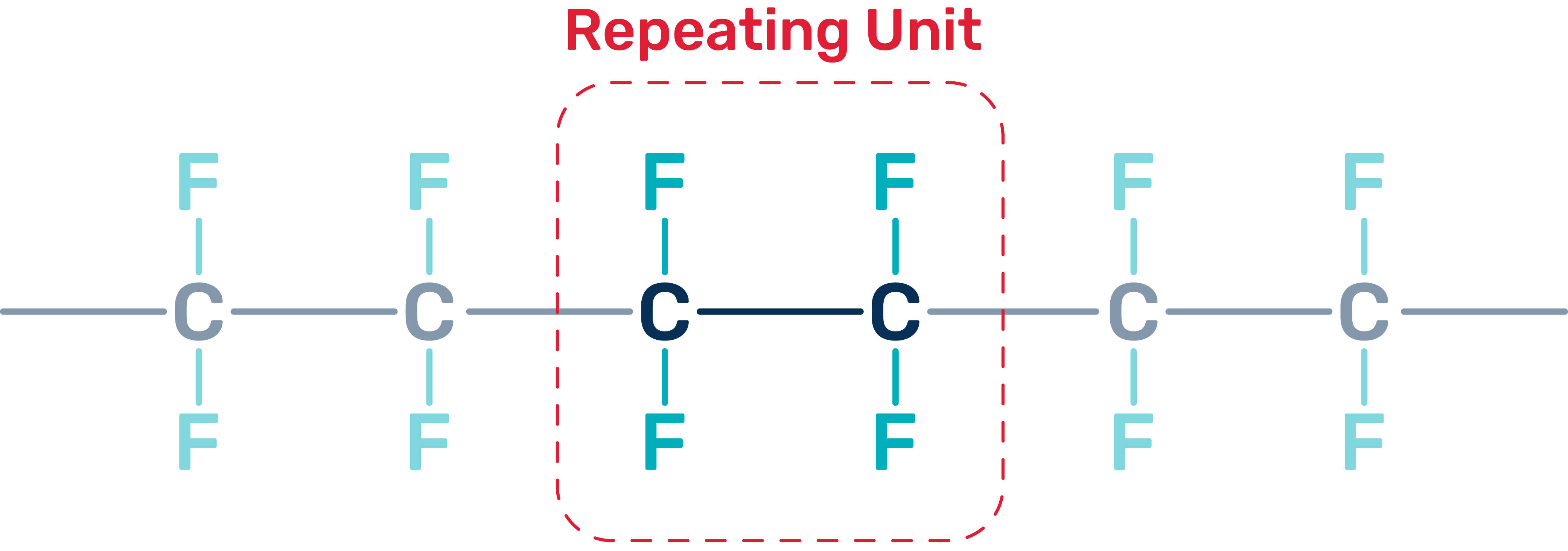
[CF2-CF2]
Key PTFE Properties
1. Excellent chemical resistance
Chemical resistance is one of the most important PTFE properties. PTFE is resistant to a broad range of industrial chemicals, solvents, cleaning agents and corrosive substances.
Chemical compatibility should always be assessed using the complete operating conditions. Concentration, exposure time, temperature, mechanical stress and the presence of chemical mixtures can all affect material performance.
2. Broad temperature performance
PTFE retains useful properties across a wider temperature range than many conventional plastics and coated materials. This allows PTFE cast films and PTFE-coated fabrics to be used in applications involving heat, cold or repeated temperature cycling.
The maximum practical operating temperature of the finished product may be determined by more than the PTFE alone. In PTFE-coated fabrics, the substrate, seams, adhesives, reinforcement and edge treatments may have lower temperature limits than the coating.
Mechanical loading must also be considered. A material may tolerate a particular temperature while stationary but perform differently when placed under continuous tension, flexing or abrasion.
3. Non-stick and release performance
PTFE has exceptionally low surface adhesion, giving cast films and coated fabrics excellent non-stick and release performance. Because of its carbon backbone, tightly shielded by fluorine atoms, it has a stable outer layer that interacts only weakly with other materials. As a result, adhesives, resins, polymers and process residues are far less able to bond to the PTFE surface.
This property is particularly valuable in tricky processing environments involving adhesives, composite resins, rubber, heat sealing, food-production surfaces, packaging materials, and other sticky or viscous products. In these applications, clean release is essential to prevent material build-up, avoid cross-contamination, and maintain consistent product quality.
Low friction is also valuable in precision components such as electromagnetic solenoids, where PTFE linings help reduce drag, prevent stick-slip and support smooth, repeatable movement. By reducing resistance between moving parts, they can improve response consistency, lower power requirements and reduce wear over repeated operating cycles.
4. Low coefficient of friction
Because other materials interact only weakly with the PTFE surface, they are less likely to bond, grip or drag against it. This contributes to PTFE’s very low coefficient of friction and allows materials to move across the surface more easily.
Actual friction depends on the mating material, contact pressure, surface finish, temperature and the presence of contamination. Low friction should therefore be evaluated under realistic operating conditions
This property is particularly valuable in demanding processing environments where materials, components or products need to move smoothly across a surface. In applications such as conveying, guiding, sliding, forming and continuous production, low friction helps reduce drag, minimise wear and support more consistent, energy-efficient operation. It can also reduce or eliminate the need for oils, greases and other lubricants that require regular replenishment, helping simplify maintenance and minimise the risk of contamination.
5. Electrical insulation
PTFE has excellent dielectric properties and low moisture absorption, making it useful as an electrical insulation material.
The same structure that creates strong chemical resistance also contributes to PTFE’s excellent dielectric properties. Because the polymer contains very few mobile charge carriers and does not readily absorb moisture, it strongly resists the movement of electric current through its bulk.
PTFE cast films are particularly suitable where a thin, continuous dielectric layer is required. PTFE-coated fabrics may be preferred where insulation must be combined with greater tear resistance, dimensional stability or mechanical reinforcement.
6. Low moisture absorption
PTFE absorbs very little moisture, helping it maintain stable surface, electrical and chemical properties in humid, wet or frequently cleaned environments. This makes it well suited to outdoor covers, electrical insulation, process belts and protective liners.
7. Weather and UV resistance
The strong carbon–fluorine bonds also make it difficult for ultraviolet radiation to break, so the polymer undergoes very little photochemical degradation. As a result, PTFE retains its surface, chemical and electrical properties during prolonged outdoor exposure, with minimal embrittlement, discolouration or loss of performance.
In communication-system concealment, Versiv microwave-transmissive fabrics protect antennas and radios from ultraviolet radiation and harsh weather while maintaining reliable signal transmission.
In space, Versiv Beta Cloth withstands solar and vacuum ultraviolet radiation, helping protect satellites, spacecraft and multilayer insulation systems without losing its mechanical or protective performance.
Versiv PTFE Films and Fabrics: Coated, Cast and Laminated Materials
Versiv offers PTFE in a range of material constructions, each designed to suit different processing requirements and applications.
Versiv PTFE-coated fabrics combine the non-stick, chemical-resistant and low-friction properties of PTFE with the strength and dimensional stability of a woven substrate such as fibreglass or aramid. They are commonly used for release surfaces, process belts, protective liners, electrical insulation and other applications requiring mechanical durability.
Versiv PTFE cast films are thin, multi-layer fluoropolymer films designed to provide a smooth, conformable and pinhole-free barrier. Their uniform construction makes them well suited to dielectric insulation, mould release, vacuum bagging, chemical protection and applications requiring controlled thickness and consistent surface performance.
Versiv PTFE laminated fabrics combine the structural strength of a coated fabric with the continuous, non-porous surface of a PTFE cast film. This construction offers the best of both materials, delivering improved barrier performance, mechanical reinforcement and a smooth, pinhole-free release surface for particularly demanding processing environments.
All three formats provide excellent chemical resistance, low surface adhesion, temperature stability, electrical insulation and resistance to moisture and weathering. However, their mechanical, surface and barrier properties differ according to their construction.
Ready to find your next solution?
Contact us today and learn more!